You installed a 240V EV charger 150 feet from your electrical panel, but it charges at half the expected speed. The issue is not the charger, the panel, or the breaker. The issue is voltage drop.
Voltage drop is the silent killer of electrical performance. Every foot of wire adds resistance, and every amp of current pushes against that resistance. The result is lost voltage at the load end, leading to slower charging times, dimmer lights, overheating motors, and in extreme cases, equipment failure.
The National Electrical Code addresses this in **NEC 210.19(A) Informational Note No. 4**, which recommends keeping branch circuit voltage drop at or below 3%, and total drop (feeder plus branch) at or below 5%. While these are recommendations rather than hard, enforceable safety requirements in every jurisdiction, most inspectors treat them as practical field standards. For sensitive systems like EV chargers, medical devices, or data centers, targeting 2% or less is common practice.
This guide covers the exact formula, real worked examples, common mistakes, and how to verify any electrical run in under a minute using a free calculator.
Calculate Voltage Drop Instantly
Use our free NEC-compliant calculator to check single-phase, three-phase, copper, and aluminum runs.
Section 1: The Voltage Drop Formula Explained
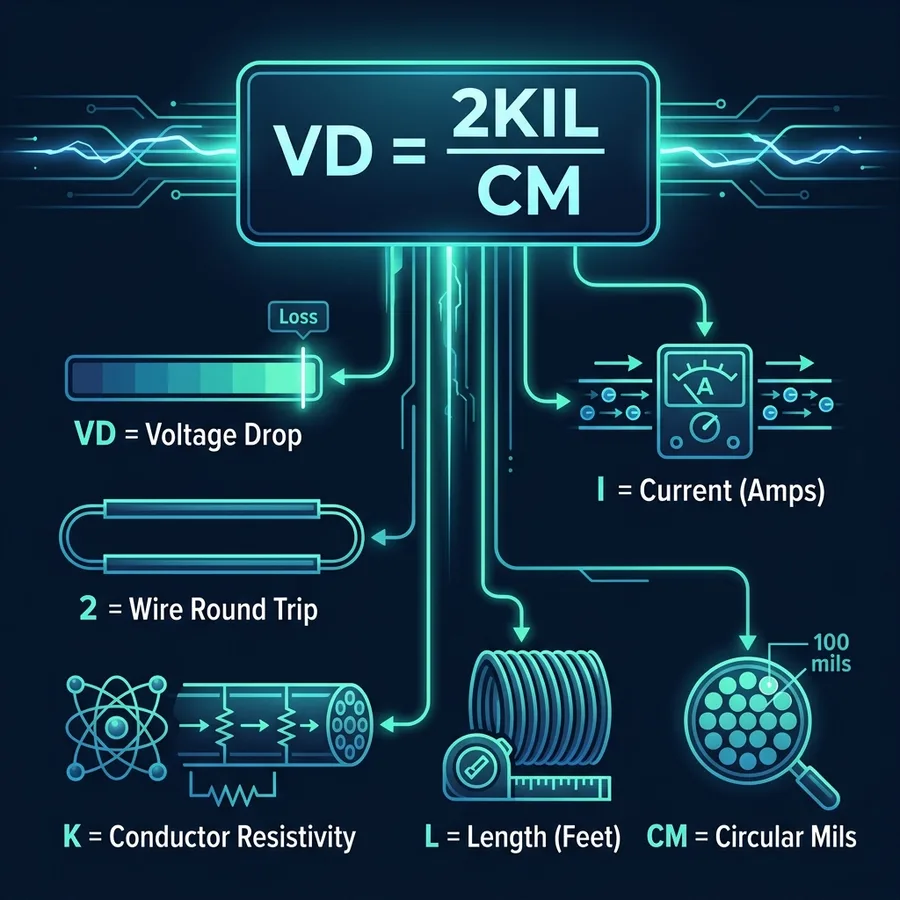
The standard NEC voltage drop calculations use the **K-factor method**:
Where:
• VD = voltage drop in volts
• 2 = multiplier for the round trip (positive and return conductors)
• K = resistivity constant (12.9 for copper, 21.2 for aluminum at 75°C)
• I = load current in amps
• L = one-way length in feet
• CM = conductor area in circular mils (from NEC Chapter 9, Table 8)
For three-phase circuits, the formula incorporates the square root of 3 (1.732) to account for phase displacement:
The 1.732 multiplier replaces the 2, reducing voltage drop by approximately 13.4% for the same wire size, length, and current. This is a primary reason three-phase systems are preferred for commercial and industrial long runs.
The standard K-factor assumes a conductor temperature of 75°C. At lower temperatures, resistance decreases and voltage drop is slightly reduced. At higher temperatures, both increase. For most residential and commercial branch circuits under normal operating conditions, the standard K-factors are highly accurate. For precise industrial calculations, temperature-adjusted K-values can be derived from **NEC Chapter 9, Table 8**.
Section 2: Why Voltage Drop Matters More Than You Think
Voltage drop is not just a code compliance recommendation; it directly impacts equipment performance, safety, and operational costs:
- Performance: A 5% drop on a 240V circuit means your equipment sees only 228V. An EV charger rated for 240V will charge slower, AC motors will run hotter with less torque, and LED drivers may flicker or fail to start.
- Safety: Undersized wire on long runs can overheat. The wire insulation degrades faster over time, and breakers may fail to trip quickly during a fault because the voltage at the end of the run is too low to sustain the required short-circuit current.
- Operating Cost: Running undersized wire and accepting higher drop wastes electrical energy as heat. Over a 10-year period, the wasted electricity can easily cost more than the initial expense of upgrading to a thicker wire size.
NEC 2026 Context
The 2026 edition of NFPA 70 maintains the 3% branch circuit and 5% total voltage drop recommendations. However, load calculations have been relocated from Article 220 to Article 120, and general lighting loads for dwelling units were reduced to 2 VA/sq. ft. to reflect modern energy efficiency. While the voltage drop limits themselves are unchanged, continuous loads like EV chargers demand strict voltage drop oversight.
Section 3: Worked Example 1 — Residential EV Charger Sizing
Let's say a homeowner installs a 50A, 240V Level 2 EV charger. The panel is 150 feet away, and the electrician initially considers running 8 AWG copper THHN. Let's calculate the voltage drop:
Step 1: Gather Values
- K = 12.9 (copper at 75°C)
- I = 50A (continuous actual load)
- L = 150 feet
- CM for 8 AWG = 16,510 circular mils (from NEC Chapter 9, Table 8)
Step 2: Calculate Voltage Drop
VD = (2 × 12.9 × 50 × 150) / 16,510
VD = 193,500 / 16,510
VD = 11.72 volts
Step 3: Convert to Percentage
(11.72 / 240) × 100 = 4.88%
Result: A 4.88% drop exceeds the NEC 3% recommendation. The charger will run hot, charging times will slow down, and the inspector may reject the installation.
The Fix: Sizing up to 6 AWG copper (CM = 26,240):
VD = (2 × 12.9 × 50 × 150) / 26,240 = 7.37 volts
(7.37 / 240) × 100 = 3.07% (Borderline, still slightly over 3%)
For a high-performing installation, upgrading to 4 AWG copper (CM = 41,740) yields:
VD = 193,500 / 41,740 = 4.64 volts = 1.93% (Excellent headroom and code compliance).
Section 4: Worked Example 2 — Commercial Three-Phase Motor
A 480V three-phase motor draws 30A. The panel is 200 feet away, and the installer plans to use 10 AWG copper.
Step 1: Gather Values
- K = 12.9
- I = 30A
- L = 200 feet
- CM for 10 AWG = 10,380 circular mils
Step 2: Calculate with Three-Phase Multiplier
VD = (1.732 × 12.9 × 30 × 200) / 10,380
VD = 134,057 / 10,380
VD = 12.91 volts
Step 3: Convert to Percentage
(12.91 / 480) × 100 = 2.69%
Result: 2.69% passes the 3% branch circuit recommendation. However, if the run length increases or the motor faces momentary load spikes, the voltage drop will increase. To assure long-term reliability and efficiency, using 8 AWG copper (CM = 16,510) drops it further to 1.69% (8.12V).
Section 5: Common Voltage Drop Mistakes in the Field
- Using the Breaker Rating instead of the Load Current: Breakers are sized at 125% of continuous load. Calculating voltage drop using 62.5A instead of the actual 50A EV charger draw leads to over-sizing wires unnecessarily.
- Forgetting the Round-Trip Multiplier: Single-phase formulas must use the multiplier of 2 because current must travel down the hot conductor and return along the neutral/return conductor. Omitting the 2 cuts the calculated drop in half.
- Ignoring Ambient Temperature: The standard K = 12.9 constant is for 75°C. Conductors routed through hot attics or rooftop conduits in direct sunlight can reach 90°C, raising wire resistance by about 8%.
- Mixing Up Copper and Aluminum K-Factors: Aluminum is a poorer conductor than copper, with a K-factor of 21.2 (roughly 64% more resistance). Using the copper constant for aluminum runs results in an under-sized, overheating wire.
- Neglecting Total Combined Drop: The NEC recommends 3% maximum for the branch circuit, but also a 5% limit for the *combined* feeder and branch circuit. A branch circuit at 2.9% coupled with a feeder at 2.5% totals 5.4%, violating the combined recommendation.
Section 6: Quick Reference Voltage Drop Table
The table below indicates the maximum one-way distance (in feet) for a **3% voltage drop** using single-phase copper conductors:
| Wire Size | 20A at 120V | 30A at 240V | 50A at 240V |
|---|---|---|---|
| 14 AWG | 25 ft | 50 ft | 80 ft |
| 12 AWG | 40 ft | 80 ft | 130 ft |
| 10 AWG | 65 ft | 130 ft | 200 ft |
| 8 AWG | 100 ft | 200 ft | 320 ft |
| 6 AWG | 160 ft | 320 ft | 510 ft |
Note: Distances are rounded and calculated based on standard conductor properties at 75°C. Actual field distances may vary slightly depending on conduit type and temperature factors.
Section 7: How to Reduce Voltage Drop on Long Runs
If your calculations indicate excessive drop, use these common mitigation strategies:
- Increase Conductor Size: The most direct method. Upgrading from 8 AWG to 6 AWG copper reduces drop by approximately 37%.
- Increase Circuit Voltage: A 240V circuit experiences half the percentage drop of a 120V circuit for the same wattage load.
- Shorten the Run Length: Relocating panels or installing sub-panels closer to major loads can eliminate long branch runs.
- Use a Sub-panel: Run a larger feeder to a local sub-panel and distribute short branch circuits from there.
Section 8: Voltage Drop in Low-Voltage Systems (12V & 24V)
Low-voltage systems (LED lighting, RV wiring, off-grid solar, and marine applications) are highly sensitive to voltage drop. At 12V DC, a 3% drop is just 0.36V, and many LED drivers will fail or dim significantly if voltage drops below 11V.
Example: A 12V LED light strip draws 5A at a distance of 50 feet. If wired with 10 AWG copper:
VD = (2 × 12.9 × 5 × 50) / 10,380 = 0.62V = 5.2% drop.
The load sees only 11.38V, resulting in dimmer light output. Upgrading to 8 AWG copper (CM = 16,510) drops the loss to 0.39V (3.25%), returning the light output to normal. For runs over 50 feet, consider upgrading to a 24V system when possible, which divides the percentage drop in half.
Section 9: Frequently Asked Questions (FAQ)
Q: Is voltage drop a mandatory code requirement?
A: Strictly speaking, NEC 210.19(A) Informational Note No. 4 is a recommendation. However, many local jurisdictions adopt it as a mandatory amendment, and manufacturers often mandate narrow voltage ranges, making compliance essential to preserve warranty and equipment longevity.
Q: How far can I run 12 AWG copper wire without exceeding 3% drop?
A: For a 20A load on a 120V single-phase circuit, the recommended maximum length is approximately 40 feet. At 240V, it extends to 80 feet.
Q: Does voltage drop affect circuit breaker sizing?
A: No. Circuit breakers are sized based on conductor ampacity and the continuous load rating factors (125% multiplier). Voltage drop calculations are performed separately to ensure efficiency and performance, not overcurrent protection.
Q: Can I use aluminum wire to save money on long runs?
A: Yes. Aluminum wire is highly cost-effective for long feeders, but because of its higher K-factor (21.2), you must size up the conductor (e.g., using 4 AWG aluminum instead of 6 AWG copper) and check compatibility with terminals.
Q: What are the voltage drop limits for solar PV systems?
A: Solar systems have stricter guidelines. To maximize output, designers target less than 2% drop on DC source circuits and less than 1% drop on inverter AC output circuits, factoring in high rooftop conduit temperatures.
Conclusion
Voltage drop is simple physics. By understanding how conductor length, material, and current interact, you can prevent performance issues before running wire. For any project, remember to:
- Measure one-way distance accurately.
- Use actual operating current, not breaker sizes, for calculations.
- Adjust K-factors for aluminum or extreme temperature environments.
- Check both branch and feeder drop separately.
Disclaimer: While our articles and tools are designed to align with the National Electrical Code, always check with local building inspectors and licensed electrical contractors before initiating physical installations.